All colonized people – in other words, people in whom an inferiority complex has taken root, whose local cultural originality has been committed to the grave – position themselves in relation to the civilizing language: i.e., the metropolitan culture.
–from Black Skin, White Masks by Frantz Fanon
This quote has taken root in my body. It has grown branches of memory which has brought to light all the times I’ve seen this inferiority complex play out within my community. Within my family.
As a Puerto Rican woman born and raised in the United States, I’ve often looked at the people I love most and asked questions about why Spanish wasn’t taught to the next generation when it was spoken so openly in my family?
Mami always switched to Spanish when she spoke with her parents or siblings and didn’t want my sister or I to know what she was talking about. Throwing our names in the conversation then turning towards me to say, “you need to learn Spanish so you know what we’re saying.”
Why was I always told I needed to learn it but was only given half-hearted lessons by Mami?
There was the time Mami sat my sister and I down infront of our family’s white board to teach us the numbers, letters and days of the week in Spanish… The time we were given childrens books in Spanish… The time my grandma brought us dolls from the island that sung songs us nursery rhymes…
When I could finally choose a foreign language to take in high school I chose Spanish. Not for the obvious reasons, though I’m sure a part of me wanted to take it to be closer to my culture, but because I knew I would hear about it if I didn’t.
A few months into my first term Mami encouraged me to speak to her, insisting thay I should be the first to speak even though I didn’t have any vocabulary to do so. She reassured me that what I was learning in school was enough. Even though my brain struggled to remember what I learned in class. Staring at the board in confusion, it was a wonder I got a passing grade. The belief that I was too stupid to learn a second language held me back, an insecurity I held on for many years.
My mother has always claimed that it was hard to speak at home since my father refused to learn. That answer has never satisfied me.
*
“But you speak slang Spanish.” My father, who doesn’t speak a second language, though not for lack of trying, according to him, said to my bilingual mother.
I had been sitting at the dining room table when I looked to my mother, sitting on the other side of me, to see how she would react. She might have shaken her head or politely pushed back; it’s a bit of a blur to me.
I sat there, confused, knowing he was wrong but not understanding why. Sure, there’s some slang within Puerto Rican Spanish, but how he said it made it sound like it wasn’t a real language.
Both my grandparents were teenagers when they married in Puerto Rico—my grandmother was 15, and my grandfather was 19—and young adults when they left the island for the mainland U.S. My grandmother only had a fifth-grade education and had to drop out of school at 11 to help take care of her siblings.
When learning about Puerto Rico’s history, I imagine my mother’s education was not any better than mine. After all, the 1960s and 1970s were a tumultuous time in Puerto Rico, with many residents leaving the island in search of better job opportunities on the mainland. It was a time of political and social upheaval, as many on the island were still fighting for independence from the U.S. Things weren’t much better in New York City, where my grandparents and their three children (later 9 in total) ended up settling.
I won’t share what little stories I know of that time because they’re not mine to share. What my family experienced when they lived in New York City, mixed with the history about what was happening on the island and in NYC in the 1960s and 70s, has helped me understand why my mother might have made the unconscious decision not to teach my sister and me Spanish. I would be remiss not to acknowledge that race is also at play here because many in my family are white or white presenting, and nobody but my grandparents speaks English with a Puerto Rican accent. They can, to a certain extent, blend into the fabric of respectable white society.
This is the curse of the United States’ brand of white supremacy. To attempt to trade in your culture and ancestry, only to receive a slice of rotten apple pie.
The only thing I remember learning about Puerto Rico in my high school history class was through the U.S. Propaganda cartoons in our textbooks, where they portrayed Puerto Rico and a few other U.S.-conquered colonies as Children that Uncle Sam needed to reeducate. Anything I’ve learned about Puerto Rico, I’ve had to go out searching for, and in the early 2000s, growing up and attending school in a pretty well-to-do suburban public school, it wasn’t as easy as it is today.
When my father commented on my mother’s slang Spanish, I must have been in my late teens or early 20s. I was still not educated enough on colonization and the understanding of how much history is hidden in language to fully understand how ignorant that comment was and yet so on brand for someone from the U.S. to say.
For a country where the majority of the population only speaks one language, they love to police it. And with Trump’s recent executive order making English the official language of the U.S., this isn’t a surprise.
Of course, this isn’t only a USian thing. I’ve lived in three European countries, including Puerto Rico’s former colonizer, Spain, and I currently reside in Germany. I’ve heard how they talk about their former colonies and the people who choose to come to Europe. I’ve heard stories from others in the global majority talk of racism and xenophobia that they’ve experienced at the hands of many nationals.
*
Like the history of the island itself, the history of Puerto Rican Spanish is complicated, blended together from all the cultures that have influenced it. When we talk about the history of the island and the language that is spoken there, we need to talk about the colonization and the racism that is baked into the culture.
It always frustrates me when I come across an author who treats all of the cultures that have influenced the island’s history and the language spoken as if the island is just this magical, beautiful melting pot of cultures. Sanitizing the way history is told does us all a disservice.
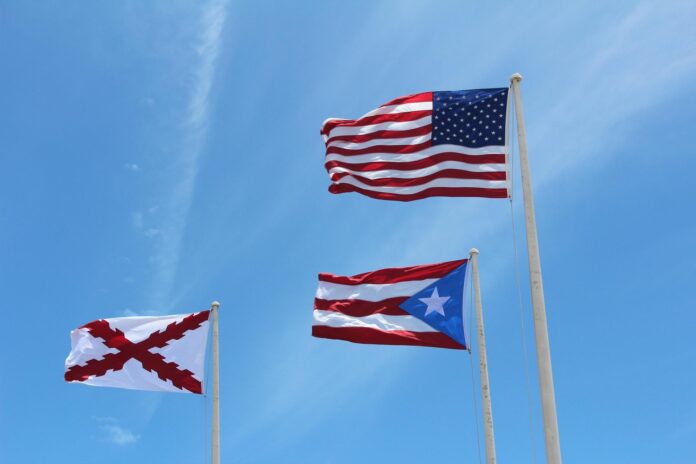
The island of Puerto Rico was colonized by the Spanish, who almost eradicated the indigenous people that were living on the island before them. Then, when they realized that they needed laborers and that they had nearly killed the entire population, they kidnapped people in Africa and brought them over as slaves to work on the island. Then, in 1898, the United States won the Spanish-American war, and rather than giving the island independence, they began to colonize it. Displacing the people at every opportunity. Promising jobs in Hawaii to thousands of people after a massive hurricane devastated the coffee and sugar industry, only for them to be met with horrible working conditions. Massacring people who went to protest, peacefully, the U.S. continued colonization of the island, making it illegal for Puerto Ricans to fly their flag or talk about independence in the 40s and 50s. Sterilizing Puerto Rican women without their knowledge, all in the name of population control. Using women as medical guinea pigs, again without their knowledge, for the first-ever trial for birth control. Using the island of Vieques to test U.S. Bombs for decades, despite people living on the island. Using various laws to make it difficult for people to get foodstuffs and goods from anywhere that isn’t the U.S. (Which contributes to higher prices on the island and was a huge issue after Hurricane Maria, when other Latin American countries wanted to send food). Shall I continue?
Puerto Rico is not a commonwealth of the United States. Puerto Rico is a colony.
All four of those cultures, Taino, various African, the United States, and Spain, have influenced the language spoken on the island. What I find most interesting, and I didn’t learn this until I lived in Andalusia, was that the dialect spoken in that region of Spain is the one that was brought over to many of the Spanish-speaking Caribbean colonies.
*
The colonized have internalized that they don’t speak the colonizer’s language the way the colonizer would like- the civilizing language. So, the language that Puerto Ricans speak gets labeled as slang Spanish or as dirty Spanish, as one woman told me. Her father said this about the Puerto Rican Spanish as a reason why he wouldn’t teach her.
In the three European countries I’ve lived in, I’ve managed to live only in areas where they speak the dialect. In Belgium, Flemish; in Spain, Andalusian; and in Germany, Swabian.
Sure, there are jokes about the way that they pronounce words and their accents, but at the end of the day, it’s still a legitimate European language. No one’s saying it’s wrong or slang.
The colonized internalize the shame of not speaking properly and then turn it on their community, policing words and accents, doing the colonizer’s work for them.
I want to be clear that I don’t blame my family for not teaching me the Spanish they knew. I only seek to understand why they didn’t, because I don’t even think they fully know. I’m simply filling in the gaps in the incomplete narrative I was told.
This happens when our history is kept from us: we cannot see the beauty of all that influenced it. And we blindly accept when we’re told it’s a history not worth telling.
I’ve had to unpack layers and layers of shit to get to the point where I’m not ashamed or embarrassed not to know Spanish well at my age.
Since Bad Bunny’s most recent album hit my ears a few days after its release on January 5, I’ve been inspired to return to Spanish lessons, which I had abandoned to focus on learning German. After watching various TikTok videos on all of the cultural and historical references hidden within the album’s songs, I decided the best thing to do would be to reclaim my mother’s tongue by learning from someone on the island and expressing my desire to learn the Island’s Spanish. It’s been something that brightens up my week and makes me feel empowered, even though I have a long way to go.
Trump’s recent executive orders made English the national language of the United States. This angered many Americans and sparked a conversation among many Latinos about how speaking Spanish should be considered a revolutionary act within the United States. I agree. But make sure it’s our brand of Spanish with all the flavor of our sazon.
There’s power in reclaiming what was stolen, forbidden, beaten out of, outlawed, and looked down on. The United States has tried to do this, both on the island of Puerto Rico and within the public education system on the mainland. It has always done this to other communities in the United States.
We can reclaim histories, humor, cultures, emotions, connections, and our communities in language.
***
***
The ManifestStation publishes content on various social media platforms many have sworn off. We do so for one reason: our understanding of the power of words. Our content is about what it means to be human, to be flawed, to be empathetic. In refusing to silence our writers on any platform, we also refuse to give in to those who would create an echo chamber of division, derision, and hate. Continue to follow us where you feel most comfortable, and we will continue to put the writing we believe in into the world.
***
Our friends at Corporeal Writing are reinventing the writing workshop one body at a time.
Check out their current online labs, and tell them we sent you!
***
Inaction is not an option,
Silence is not a response
Check out our Resources and Readings
