
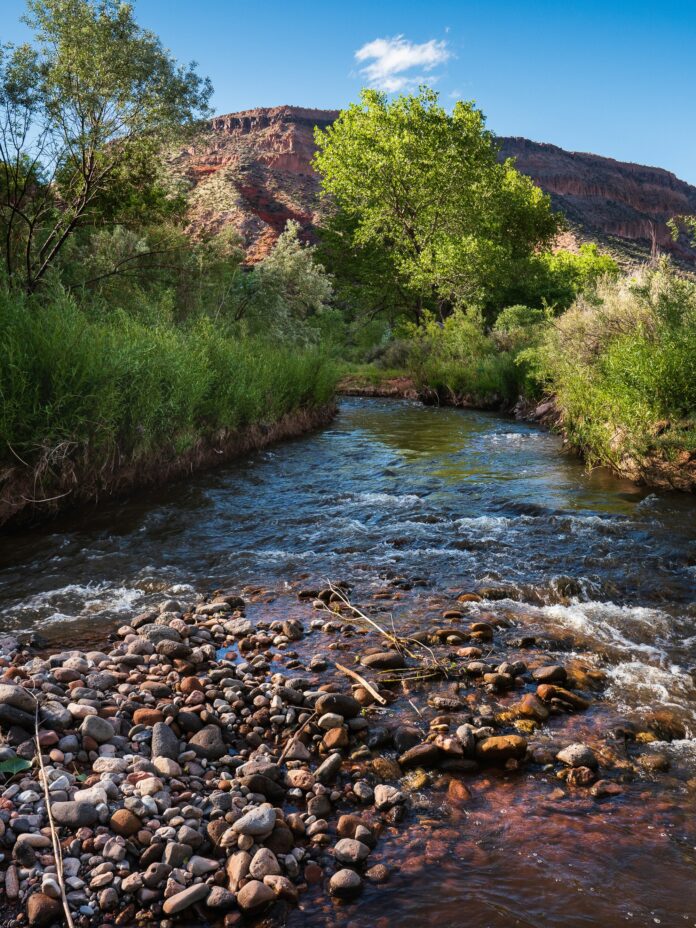
In New Mexico, I visit the river near my home, intermittent and illusive, which wears a skin of ice, thin as an envelope, engraved with leaves and patterns of sand. I hold a shard in my hand until it melts, then drips back into the bank. Water bubbles under the sheaths made solid and buoyant. Blue birds flock and sip, flash in flight, return to bare branches and perch. Ice crackles under the dog’s paws and he skitters. Don’t worry, I say, it’s shallow. Don’t worry, I tell myself, this river is a prayer of impermanence.
On the riverbank, a man I have grown used to seeing, has packed up his camp and moved to some other temporary home. When I passed, he never looked up or waved back, lay often on the ground, knees bent, like a boy in the dirt. He built a small tent out of solar panels that folded up and fit on his bike. A priest of the hill, he kept his bearded head down. His possessions: a bike and eyeglasses, a book and greasy shirt, pants held up with a belt, scuffed boots. Sometimes, we shared silence for a while in a way I didn’t with anyone else. I sat in the willow chair under his camp praying my own versions of praise to river water that trickled and dried up. One day I arrived to sit in quiet with him but sat alone that day.
My father was also a drifter. He wore wool in the war, skiing the Italian alps. He was seventeen years old, a painter. He brought back a gun as a souvenir and my brothers played war with the gun in the ditch. He cussed at the mud, went missing in his mind. He spent the years of our childhood still battling in that world’s war. His prey were his small bald boys. His turf, snowy slopes. We skied with him as far as we could. Eventually, he lived in his van outside our home, stopped shaving. His quicksand past: each year he slipped further underground. All his stories were about snow, and the gun of young man he killed. He took up racewalking, walking as fast as he could from his terror and grief. His clothes were covered in filth; he ate Vienna sausages out of a can. Crumbs in his beard, eyes bright as blue birds: look of madness winging there. His brows grew long enough to trim.
At Albuquerque Healthcare for the Homeless, folks carried their belongings in plastic bags or back packs. They often had their IDs stolen by the police or other campers. One woman lived in her car with her faithful dog who wouldn’t let anyone near her body for hours after she died from an overdose. Another offered me his only food, an apple. One elderly man lost his shoes and socks and walked miles for help. His feet were wet and swollen. He told us he was looking for his grandmother, dead for decades. Many families with children were temporarily housed in a huge shelter or in motels. Our clinic had an art studio where human stories were told, dripping in paint, standing in sculptures made of wood and stone.
One hot spring day, I meet a man called Dragon again after many months, sitting in the shade of a bridge, traffic above, rattling the struts. When we met before, he had long dreadlocks and a bevy of scarves wrapped around his neck, the colors of fire, made by women at the shelter who appreciated his protection. Today he is thin in a tee shirt and jeans, his hair trimmed short.
He is an army vet who lost the home he shared with his dad after his dad died and the old Cadillac he left his son was impounded, fees too expensive to reclaim.
Dragon has a short fuse and runs after a man, who is wearing a thick coat and wool hat, and walks by saying no, no, no. Dragon thinks he called him a ‘homo’ and feels like harming the guy. He tells me he just uses a little crystal and pot but doesn’t trust that anyone can really help him get housed. Each time I meet him, I think of my father and his wild mind after the war, his rages. Dragon is a mostly a kind man, and I don’t feel at all afraid of him, though I see how he could be intimidating. He has plans to move his grocery cart full of belongings down nearer to the river into a shady place in the distance. On my way back up the trail I see the man in the coat and hat, wave to him. No, he repeats, no, no, no.
Strangers arrived at my father’s military funeral where just a few family members gathered. They were young athletes who told us they admired his race-walking techniques. How odd to surrender our knowledge of him to admirers we never met. All the tiny white crosses rooted on trim green lawn. The three-gun salute would have startled him. My young nephew touched the coffin as if it were mystery itself. He kept his hand there until led away to make room for the numerous other memorials that day, as multiple soldiers were buried in the ground, many who had lived on the street for years before dying.
A woman I talk to on the trail is upset because the homeless don’t pick up their trash. She wonders how she can help them learn to care about litter. She seems to be a caring person, empathetic in many ways. And yet ‘the homeless’ as many call them are often misunderstood and demonized. Life on the street is precarious. Unhoused women tried to attach themselves to ‘safe’ men to sleep in a pod but three young men were murdered while dreaming in a field one night near my home. I say to her—imagine tonight without a place to stay and little to no money and maybe a sleeping bag but maybe that got taken with your ID and see where your priorities lie.
Another habitat at the end of the trail: shopping carts full of coolers and old shoes. Dugout made of a blue tarp. Large metal cart with huge wheels, one askew. Boards over mud, a sign “Old and Hungry”. A bearded man with one tooth, examining his things. A wheel fell off and the horses ran away, he says to me when I stop to chat. He says bless you as I walk away. When I pass going back, he is coughing under his blue home in the dirt.
I want to say I loved my father though love seemed elusive sometimes. His limbic brain was often raging or in panic. He was cruel and violent at times but made us laugh when he mimicked cartoon characters. He taught us to explore mountains but skimped on things like healthy food for his family. His moods were intermittent, trickling or flooding or dry, like the river near home where flow is released when the city’s drinking water reservoir is full or being repaired. Or from spring melt, storm washed from gutters.
I approach a woman I have been watching on the river for several days. She is arranging stones in the riverbed in long rows and piled at the base at young trees which were planted on the bank to create a small river cottonwood bosque. She throws rocks onto the trail when I approach, andstops to apologize for scaring me. I assure her I’m not afraid and just wonder what she is doing. She says she puts the stones near trees, so they don’t fly off. The stones keep trees rooted in the ground, she believes. She is worried about metal in the water, asks me where all that metal comes from. Her teeth are black and rotting, often a sign of methamphetamine use. I go for common ground: we both care about the trees, thank her for caring. Reassure her the roots are deep and keep the trees in the earth and some of the metal comes from the ground. She wonders about the danger of dams and asks my name. Our names rhyme and we laugh about that.
My father lost his job, his home, his family, his mind, his dream of being an artist, his sturdy boots. He lost his gods and his washcloths. In the end he was alone in a white room in Texas where my brother moved him because it was cheap. Now he is grass, a prayer of soil. We were not allowed to attend the burial, but he has a numbered cross somewhere in the thousands of crosses, indistinguishable. He would have liked that, a perfect disappearing act, one he had practiced so many times before. Once, on a high mountain cliff, he yodeled loudly, and his voice came echoing back across the rift. In a swift wind, our hats blew off and drifted away with the winnowing notes of his song.
By mid-summer the river is mostly dry. People living on the banks have moved to more shade. I sit in its sandy bed, which sifts through my fingers. Temporary as water, a breeze shakes cottonwood leaves into shimmer, and tiny mirrors in stones reflect the hot light.
***
***
The ManifestStation publishes content on various social media platforms many have sworn off. We do so for one reason: our understanding of the power of words. Our content is about what it means to be human, to be flawed, to be empathetic. In refusing to silence our writers on any platform, we also refuse to give in to those who would create an echo chamber of division, derision, and hate. Continue to follow us where you feel most comfortable, and we will continue to put the writing we believe in into the world.
***
Our friends at Corporeal Writing are reinventing the writing workshop one body at a time.
Check out their current online labs, and tell them we sent you!
***
Inaction is not an option,
Silence is not a response
Check out our Resources and Readings

Thank you so much for this Tina. Of course there is much pain in this piece but wow there is so much beauty as well. I do not know these worlds that your characters inhabit. What I mean by that is that of course they are familiar places like rivers – in winters and in summers – but I have never visited these particular ones. So thank you so much for being my tour guide, and for introducing me to a bunch of characters who of course have their challenges, right alongside many other traits, some of which sparkle with perfection.