
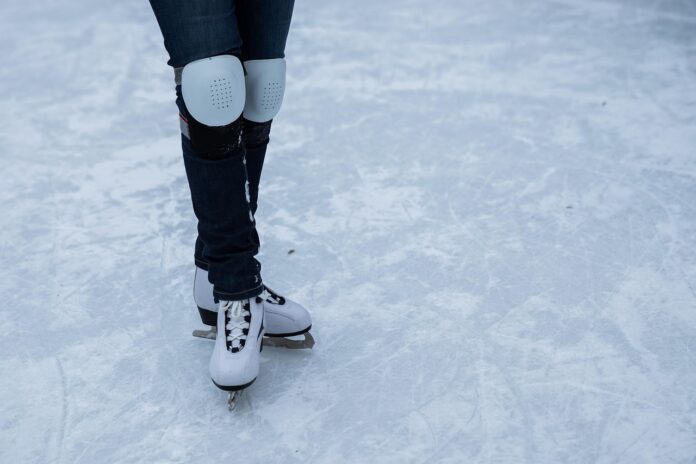

I signed up for 6 weeks of figure skating lessons in the Learn to Skate Program at the age of 34 years old during an 110-degree Fahrenheit summer heat wave in Phoenix, Arizona. Catastrophic thoughts of falling on ice and not being able to walk filled my mind after I signed up online. I questioned my sanity and whether it was too self-indulgent to register for figure skating lessons during the middle of the workday.
On the first day of figure skating class, I felt like I jumped into the deep end of a pool without knowing how to swim. As I stepped onto the ice with rented hockey skates, three Gen-Z figure skating coaches yelled out terms that I’d never heard before during the warm-up:
“Forward swizzles!”
“Backward swizzles!”
“One-foot glide!”
I was left entirely confused and looked around the rink for comradery – laughing nervously and making eye contact with an 11-year-old, Mila, who also didn’t know what was going on. As we separated out into groups in the middle of the ice rink when the warm-up ended, I was in a group that was beyond my level – Basic 4, when I should have been placed in Basic 1. I spent the rest of my time in the class doing crossovers, two-point turns, and forward pumps in a circle, while questioning my decision to sign up for figure skating lessons. I sweated profusely and tried not to fall, as I pretended to understand the instructions. At the end of the 45-minute class, I was shaken with fear and a sense of relief, grateful that I did not injure myself.
While cleaning out my closet, I found a photo of myself at 4 years old in a pink jumpsuit at the University of Guelph rink in Ontario, Canada. As a child, I grew up watching Michelle Kwan and Kristi Yamaguchi at the Winter Olympics on TV. Seeing Asian American women represented in sports gave me a sense of belonging growing up as a Chinese Canadian American girl.
Figure skating is a humbling sport because people fall and get up all the time. In my second figure skating class, I decided to put myself at a lower level. I put myself in a Basic 1 group with 3- and 4-year-olds, who barely knew how to talk. I was 34 years old. I saw my toddler classmates fall and get up constantly, without holding any judgment to themselves. In the group, I learned the skills of forward swizzles, skating backwards, and one-foot glides with increasing confidence.
After my second figure skating class, I purchased my first pair of figure skates after being sick of using the rental hockey skates. The store clerk recommended Jackson Ultima Excels. I went home and opened the box and saw in the instruction booklet that Jackson Ultima’s headquarters were in Cambridge, Ontario, Canada, about a 25-kilometer car ride away from where I was born in Guelph, Ontario, Canada.
While I was terrified of injuring myself during figure skating classes, I ended up injuring myself during dance class. I jump kicked way too high on my right leg during GloRilla ft. Sexyy Red’s “Whatchu Kno About Me.” I felt my right hamstring overextended and immediately regretted my decision on trying to do jump splits in front of class. I could not bend down without wincing in pain. I questioned my age and abilities, thinking about how I was going to turn 35 years old in November. Was this me trying to reclaim my youth and realizing it was too late?
After taking a week off to recover from my hamstring injury, I learned how to master the one-foot glide in my fourth figure skating class. In the last class of the session, I passed my Basic 1 evaluation test and felt elated. I signed up for figure skating lessons being genuinely terrified of not being able to complete the class. I came out of the lessons feeling confident about my abilities, overcoming fear, and knowing that it is never too late to still learn at midlife. Ice skating is truly one of the most joyful things I have ever experienced in my life – taking me back to my home and a sense of belonging as a Chinese Canadian American midlife woman.
***
***
The ManifestStation publishes content on various social media platforms many have sworn off. We do so for one reason: our understanding of the power of words. Our content is about what it means to be human, to be flawed, to be empathetic. In refusing to silence our writers on any platform, we also refuse to give in to those who would create an echo chamber of division, derision, and hate. Continue to follow us where you feel most comfortable, and we will continue to put the writing we believe in into the world.
***
Our friends at Corporeal Writing are reinventing the writing workshop one body at a time.
Check out their current online labs, and tell them we sent you!
***
Inaction is not an option,
Silence is not a response
Check out our Resources and Readings

